Key Takeaways
- Vehicle-to-load technology lets an EV power individual appliances, tools, and devices through built-in outlets or a charge-port adapter.
- V2L requires no electrical installation, permit, utility program, or bidirectional home charger.
- A typical EV battery stores 60-100 kWh, about 30-50 times the capacity of a 2-3 kWh portable power station.
- V2L output ranges from about 1.5 kW on some vehicles to 10.2 kW on high-output electric trucks.
- V2L can provide portable or short-term emergency power, but it cannot energize a home's electrical circuits like V2H.
Your electric vehicle isn’t just transportation. It’s a massive portable power station.
A typical EV battery holds 60 to 100 kilowatt-hours of electricity. For context, a high-end portable power station might hold 2 to 3 kilowatt-hours. Your EV has 30 to 50 times more capacity. Vehicle-to-load technology, known as V2L, lets you tap into that capacity to run appliances, tools, and devices anywhere you can park.
No special installation. No utility programs. No electrician required. If your EV has V2L capability, you can plug in and start using it today.
What Is Vehicle-to-Load (V2L)?
V2L is the simplest form of bidirectional EV power. It lets you draw AC electricity directly from your vehicle to power external devices, essentially turning your car into a portable generator.
Unlike V2H (vehicle-to-home) or V2G (vehicle-to-grid), V2L doesn’t connect to your home’s electrical panel or the utility grid. You simply plug devices into outlets on or in your vehicle. There’s no installation, no permits, and no special equipment beyond what comes with the car.
Here’s how V2L fits into the broader family of bidirectional charging technologies:
| Technology | What It Powers | Installation Required? | Special Equipment? |
|---|---|---|---|
| V2L (Vehicle-to-Load) | Individual devices plugged into the car | No | Usually just an adapter |
| V2H (Vehicle-to-Home) | Your home’s electrical circuits | Yes | Bidirectional charger + transfer switch |
| V2G (Vehicle-to-Grid) | The utility grid (you get paid) | Yes | Bidirectional charger + utility enrollment |
V2L is the gateway to bidirectional EV capability. It’s widely available on current vehicles, works out of the box, and gives you a taste of what your EV’s battery can do beyond driving. For deeper home integration, check out our guide to V2H. To learn about selling power back to the grid, see our post on V2G.
How Does V2L Work?
Every EV has an onboard charger that converts AC power from the grid into DC power to charge the battery. V2L-equipped vehicles also have an inverter that works in reverse, converting DC battery power back into AC electricity you can use.
V2L-capable vehicles provide this power through one or more options:
Built-in outlets: Many EVs have standard 120V household outlets in the cabin, frunk (front trunk), or bed (for trucks). You plug in devices directly, just like plugging into a wall outlet at home.
Exterior outlets: Some vehicles, especially trucks, have weatherproof 120V or 240V outlets on the exterior, designed for tailgating, job sites, or camping.
Charge port adapter: Some EVs provide V2L through an adapter that plugs into the charging port, converting it into a power outlet. This is common on Hyundai and Kia EVs.
The vehicle manages the power flow automatically. You can typically set a minimum battery reserve so you don’t accidentally drain the battery completely and strand yourself. When the battery reaches your set minimum, V2L shuts off.
V2L doesn’t require the complex bidirectional charging protocols (like ISO 15118-20) that V2H and V2G need. It’s a simpler system where the vehicle’s internal inverter just outputs AC power through built-in outlets or an adapter. That’s why V2L is available on many vehicles today, while true V2H and V2G remain limited.
Which EVs Have V2L?
V2L is far more widely available than V2H or V2G. Many current EVs include it as a standard or optional feature.
Trucks with V2L (high power output):
| Vehicle | V2L Power Output | Outlets |
|---|---|---|
| Ford F-150 Lightning | Up to 9.6 kW (with Pro Power Onboard) | Bed outlets, frunk outlet |
| Chevy Silverado EV | Up to 10.2 kW | PowerBase bed outlets |
| GMC Sierra EV | Up to 10.2 kW | MultiPro Midgate outlets |
| GMC Hummer EV | 3.0 kW | Bed outlets |
| Rivian R1T | 1.5 kW | Bed outlets, gear tunnel |
| Tesla Cybertruck | Up to 9.6 kW (from bed 240V outlet) | Cabin and bed outlets |
SUVs and cars with V2L:
| Vehicle | V2L Power Output | How It Works |
|---|---|---|
| Hyundai Ioniq 5 | 1.9 kW (US) / 3.6 kW (other markets) | Charge port adapter + interior outlet |
| Hyundai Ioniq 6 | 1.9 kW (US) | Charge port adapter + interior outlet |
| Kia EV6 | 1.9 kW (US) | Charge port adapter + interior outlet |
| Kia EV9 | 1.9 kW (US) | Charge port adapter + interior outlet |
| Kia Niro EV | 1.9 kW (US) | Charge port adapter + interior outlet |
| Genesis GV60 | 1.9 kW (US) | Charge port adapter + interior outlet |
| Genesis GV70 Electrified | 1.9 kW (US) | Charge port adapter + interior outlet |
| Rivian R1S | 1.5 kW | Cargo area outlet |
Note: The Hyundai/Kia/Genesis vehicles are limited to 1.9 kW in the US market, though they support higher output in other regions. This is still enough to power most household devices, just not several high-draw items simultaneously.
The Ford F-150 Lightning and Chevy Silverado EV stand out for sheer power output. The Lightning’s Pro Power Onboard system offers 2.4 kW standard, with 9.6 kW available on higher trims. That’s enough to run power tools, large appliances, or even serve as temporary power for a small event.
What Can You Power with V2L?
The answer depends on your vehicle’s V2L power rating and the devices you want to run.
Understanding power ratings:
-
1.5-1.9 kW: Enough for most individual devices, one at a time
-
2.4-3.6 kW: Can run multiple moderate devices simultaneously
-
7.2-10.2 kW: Near whole-home capability; can run major appliances
Common devices and their power requirements:
| Device | Typical Wattage | Works with 1.9 kW? | Works with 9.6 kW? |
|---|---|---|---|
| Air compressor | 1,500-2,000W | No | Yes |
| Electric heater | 1,500W | No | Yes |
| Hair dryer | 1,000-1,800W | No | Yes |
| Circular saw | 1,200-1,500W | No | Yes |
| Microwave | 1,000-1,500W | Marginal | Yes |
| Coffee maker | 600-1,200W | Yes | Yes |
| Full-size refrigerator | 150-400W running | Yes | Yes |
| LED TV (55”) | 80-120W | Yes | Yes |
| Mini fridge | 50-100W | Yes | Yes |
| Laptop | 50-100W | Yes | Yes |
| Electric cooler | 40-60W | Yes | Yes |
| CPAP machine | 30-60W | Yes | Yes |
| Smartphone charger | 5-20W | Yes | Yes |
For vehicles with 1.9 kW output, stick to running one major device at a time. The Ford Lightning or Silverado EV can run multiple high-draw devices simultaneously, making them particularly useful for job sites, events, or emergency backup.
Practical V2L Use Cases
V2L shines in situations where you need portable power away from home, or temporary backup during short outages.
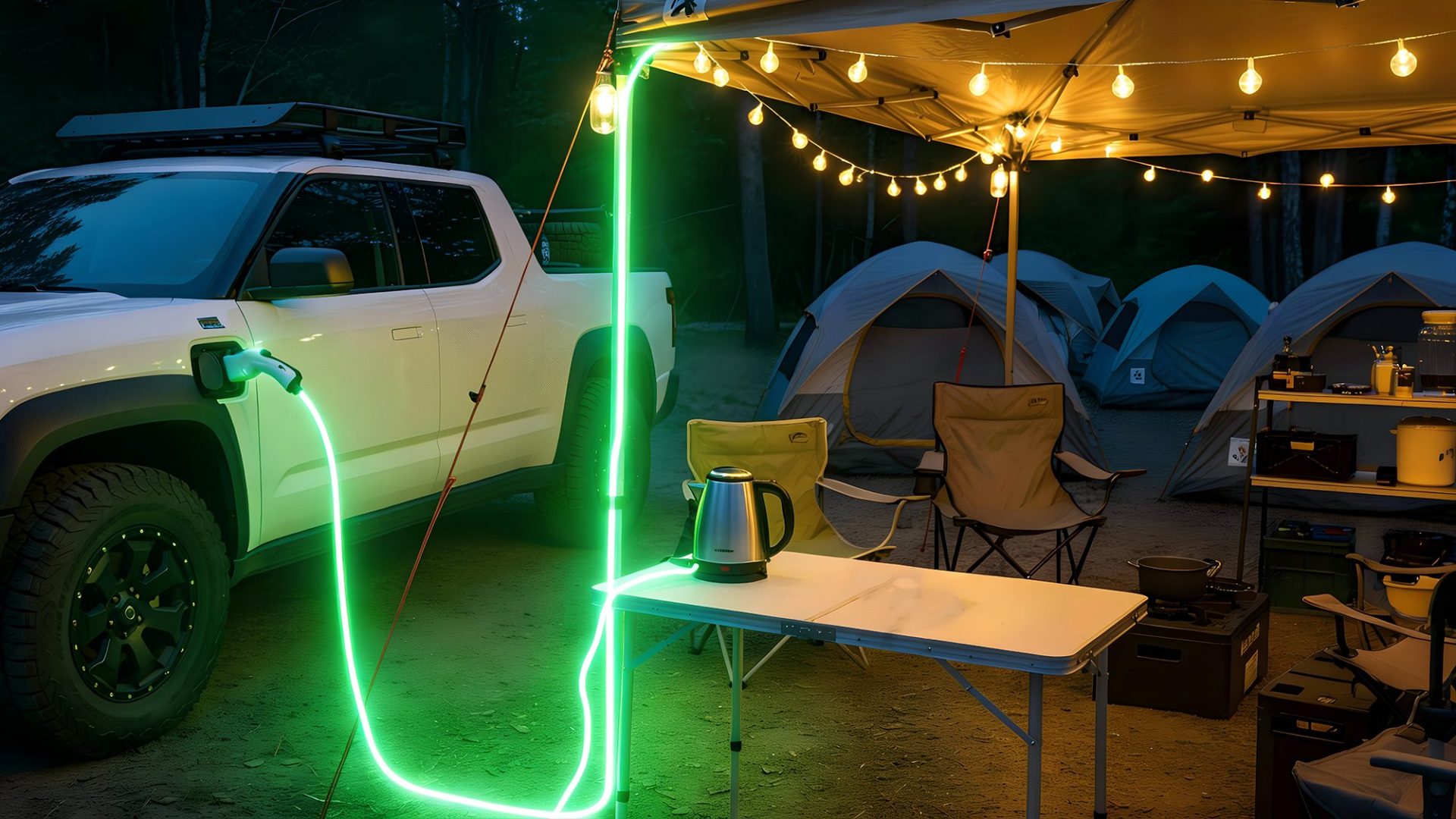
Camping and road trips: Run a portable fridge, charge devices, power lights, make coffee in the morning, or set up an outdoor movie with a projector and speakers. V2L makes camping significantly more comfortable. No generator noise, no gasoline, just silent, clean power from your car.
Tailgating: Power a TV for the game, run an electric grill, keep food and drinks cold. The F-150 Lightning has become popular in tailgating culture precisely because of Pro Power Onboard.
Outdoor events: DJs, small bands, and event organizers use V2L to power sound systems, lighting, and other equipment in locations without grid power. A single EV can provide hours of power for a small event.
Job sites: Contractors use V2L-equipped trucks to run power tools where there’s no electrical service. Circular saws, drills, compressors, and work lights can all run from the truck. It’s cleaner and quieter than a gas generator.
Emergency backup (limited): V2L isn’t the same as V2H. It can’t power your home’s circuits directly. But during a short outage, you can run critical devices by plugging them directly into your car: a refrigerator (with an extension cord through a window), medical equipment, lights, fans, or a space heater. It’s not as seamless as V2H, but it can get you through.
Charging other EVs: Some V2L systems can charge another electric vehicle using a portable Level 1 or Level 2 charger. It’s slow (you’re essentially moving energy from one battery to another), but it can rescue a stranded EV in a pinch.
V2L vs. V2H: Know the Difference
V2L and V2H both let you use your EV’s battery for purposes beyond driving, but they work very differently.
| Aspect | V2L | V2H |
|---|---|---|
| What it powers | Devices plugged into the car | Your home’s electrical circuits |
| Installation | None | Bidirectional charger + transfer switch |
| Cost | Usually included with vehicle | $8,000-15,000 installed |
| Convenience | Must run extension cords | Powers home normally |
| Power output | 1.5-10.2 kW | 9.6-11.5 kW |
| Outage backup | Temporary, devices only | Full home backup for days |
| Best for | Portable power, camping, job sites, short emergencies | Extended outages, daily TOU optimization |
If your goal is whole-home backup during extended outages, V2L isn’t the answer. You’ll want V2H, which requires a bidirectional charger installation but integrates properly with your home. Check out our guide to V2H to learn more.
V2L is best for portable power and situations where running an extension cord from your car is practical.
Tips for Getting the Most from V2L
Know your limits. Check your vehicle’s V2L power rating and don’t exceed it. Running too many devices at once can trip the vehicle’s breaker and shut off power.
Set a battery reserve. Most V2L-equipped vehicles let you set a minimum battery level so you don’t drain the battery completely. Set it high enough that you can still get home.
Plan for range impact. Every kilowatt-hour you use for V2L is a kilowatt-hour you can’t use for driving. If you’re camping 100 miles from home, be mindful of how much energy you’re using.
Use appropriate extension cords. For outdoor use, use cords rated for outdoor conditions. For higher-draw devices, use heavier gauge cords to avoid voltage drop and overheating.
Consider an adapter. For Hyundai, Kia, and Genesis vehicles, the charge port adapter is required for exterior V2L use. Make sure you have it with you when you need it. Some owners buy a spare to keep in the car.
V2L: The Portable Power You Already Own
V2L is the most accessible form of bidirectional EV power. If your vehicle has it, you don’t need to install anything or sign up for any programs. You already have a massive portable generator sitting in your driveway.
For camping, tailgating, job sites, or emergency backup, V2L turns your EV into one of the most versatile tools you own. And as bidirectional technology advances, the same EV that powers your campsite today could power your entire home tomorrow with a V2H setup, or earn you money by exporting to the grid with V2G.
To learn about whole-home backup, see our guide to V2H (vehicle-to-home). To explore the future of selling power back to the grid, check out our post on V2G (vehicle-to-grid).
The Level 2 charger that installs on nearly any panel.
PowerSmart load management eliminates the $3,000-$8,000 panel upgrade most homes need.