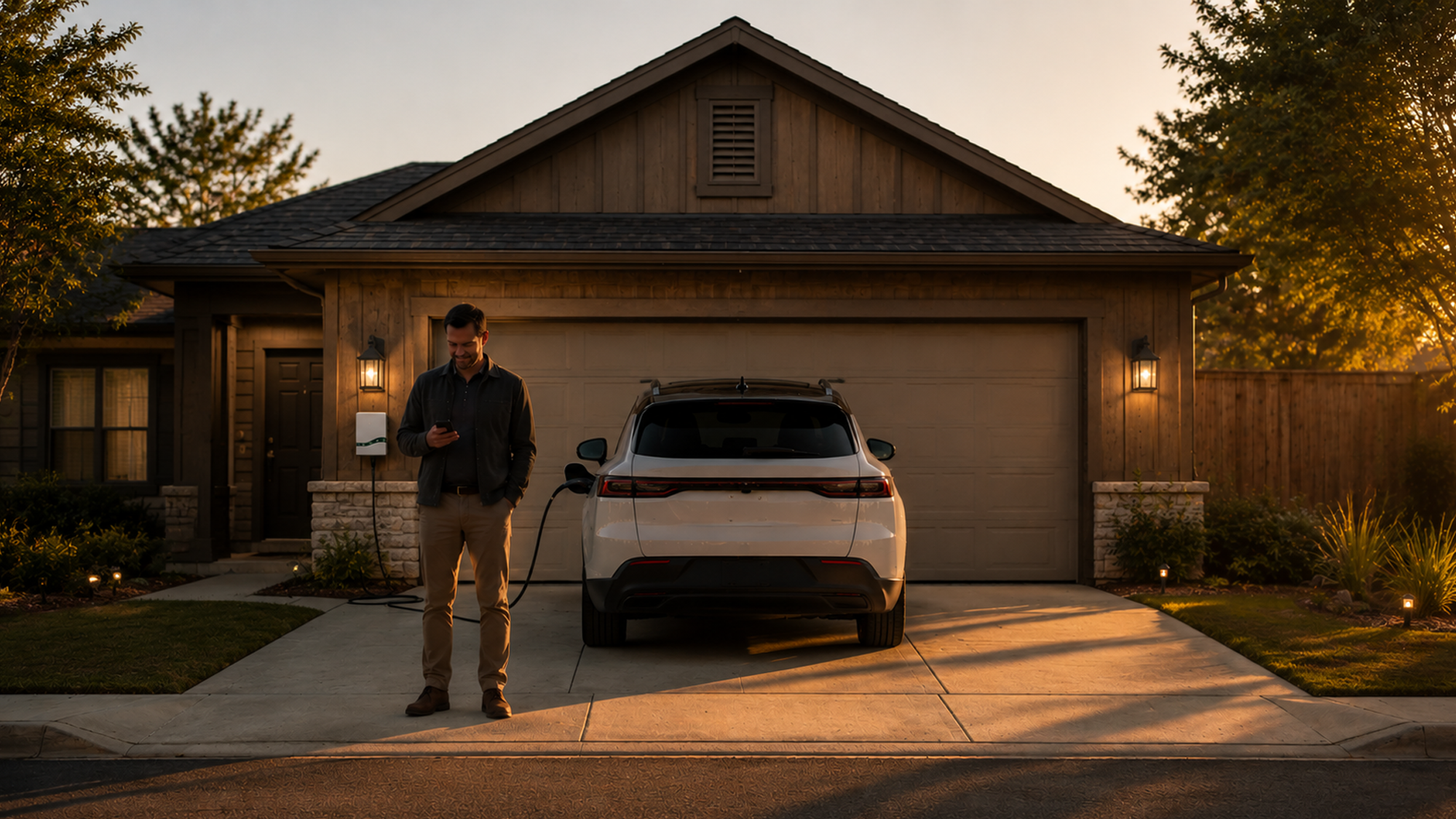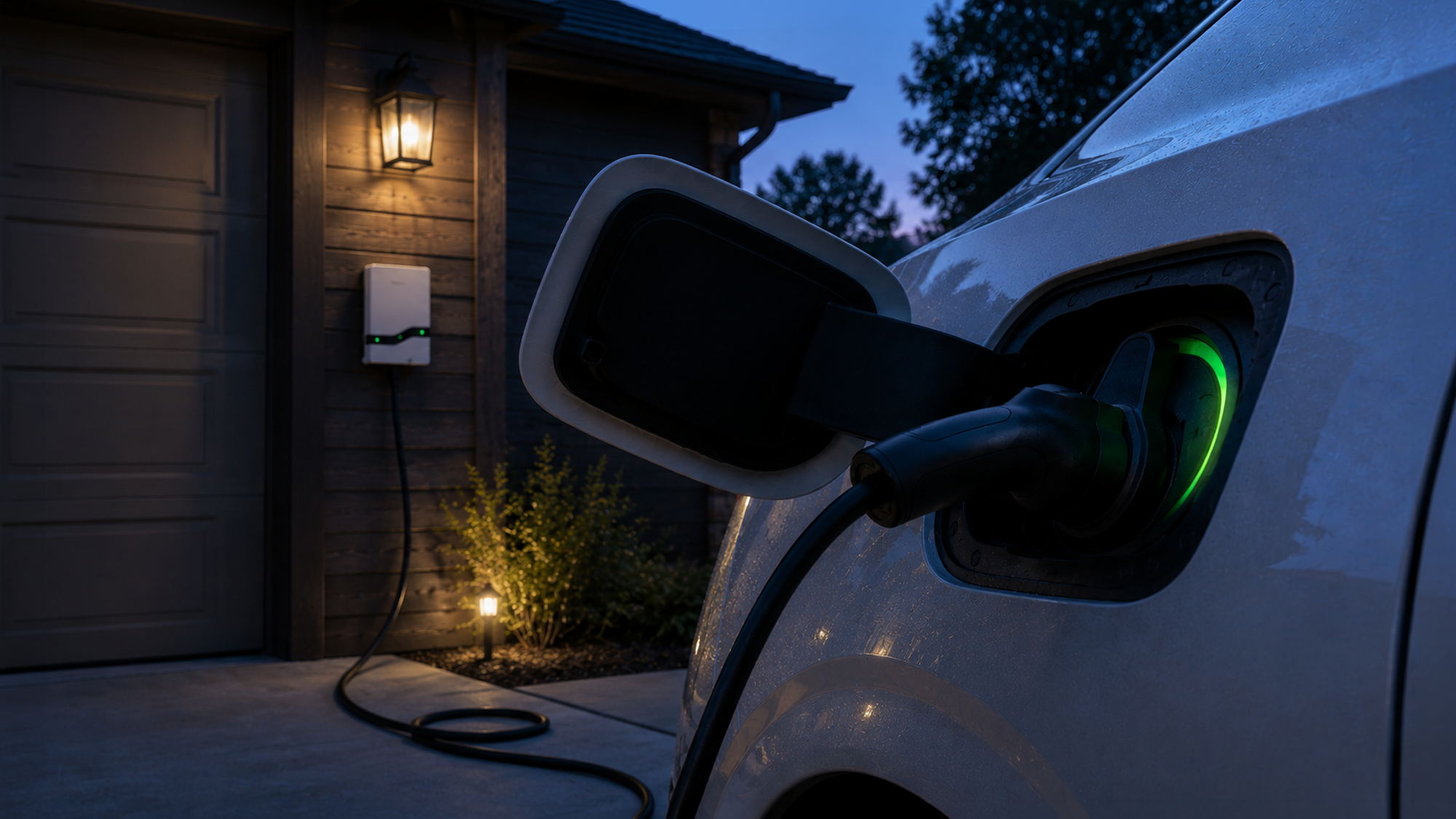
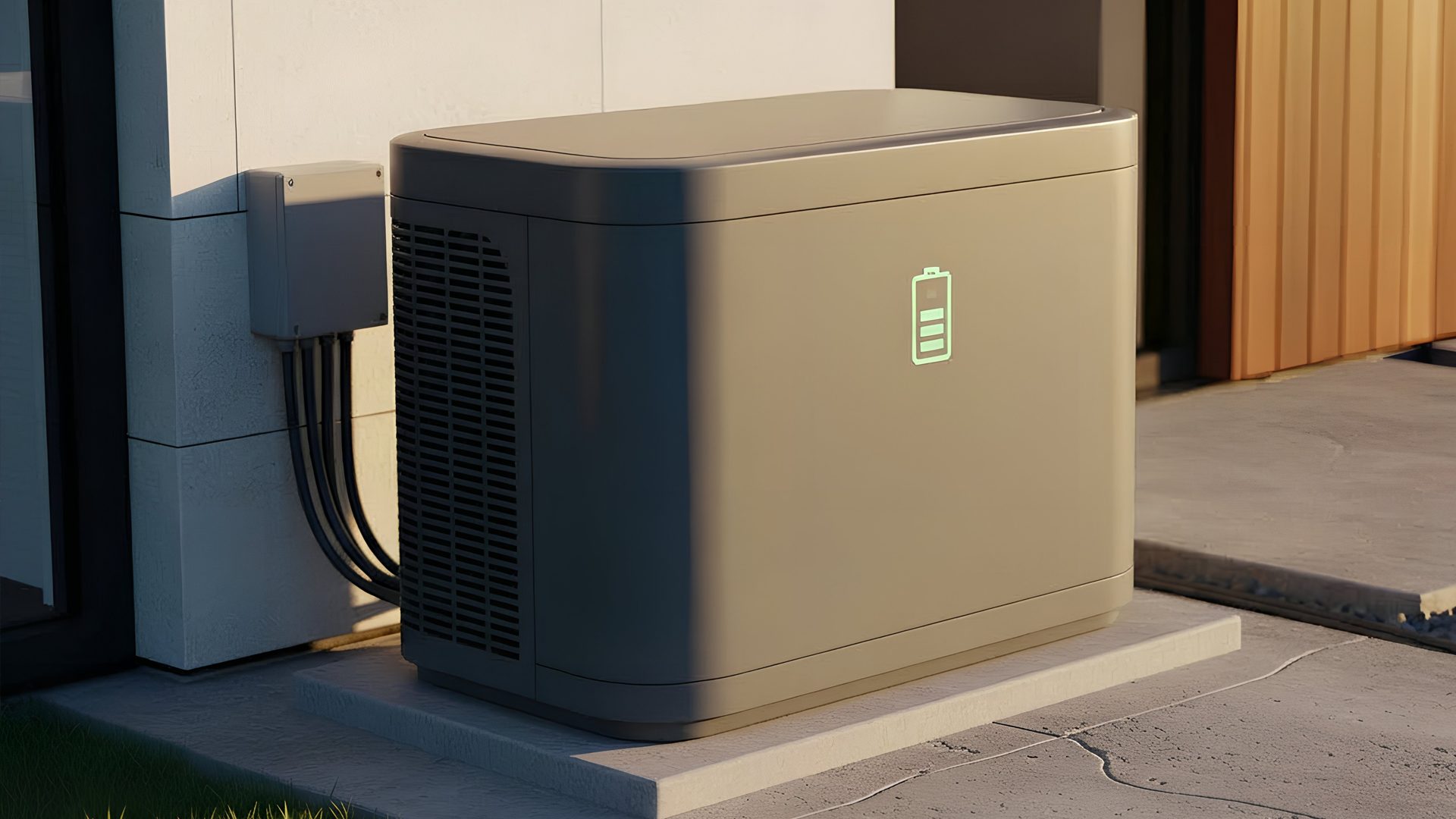
Take a look at the side of almost any house in your neighborhood and you’ll probably see an AC unit sitting on a concrete pad, maybe a standby generator next to it. Big beige boxes, utilitarian, with curb appeal as a secondary priority. Nobody designed them to look good or positioned them where guests would see them. They sit there doing their job, essential but out of the way. This is what success looks like for home technology: when something becomes truly essential, it stops trying to be impressive.
Now think about home batteries today. They’re sleek, wall-mounted, and carefully positioned with premium finishes and design awards. They’re the kind of thing you might actually show a guest who’s interested in technology. Beautiful products that cost $15,000 to $20,000 installed and are in fewer than 2% of American homes.
The trajectory is clear: home batteries are about to make the same journey that every successful home technology eventually makes, from premium product to essential appliance, from conversation piece to invisible infrastructure. And that transformation is being driven by market forces that are converging right now.
How We Got Here: The Premium Era
When home batteries first entered the residential market about a decade ago, the premium positioning made complete sense. Battery cells were expensive because the automotive industry was competing aggressively for limited supply. Every major automaker was racing to scale up EV production, and home energy storage was a small player competing for the same lithium-ion cells.
Early adopters valued design and status. If you were spending $20,000 on a home battery system, you wanted something that looked the part. The Tesla Powerwall set the standard with its clean, minimalist design. Other manufacturers followed suit. The message was clear: this is a premium product for sophisticated homeowners who care about both technology and aesthetics.
The business model reinforced this positioning. Installation was complex, requiring specialized expertise. Sales cycles were long, involving multiple consultations and custom designs. Companies built out commissioned sales teams to educate customers and close deals. All of this made sense when you were selling a luxury good to early adopters with high household incomes.
The result was predictable: installed costs landed somewhere between $1,000 and $1,500 per kilowatt-hour of storage capacity. A typical 10 kWh system would run $15,000 or more after installation. At that price point, home batteries remained a niche product for wealthy homeowners who could afford to make an environmental statement or wanted the peace of mind of backup power regardless of cost.
This wasn’t wrong. It was appropriate for the market conditions at the time. But those conditions have fundamentally changed, and the industry needs to change with them.
Two Forces Rewriting the Economics
Two major shifts are happening simultaneously, and their convergence is creating an entirely new market dynamic for home batteries.
The first force is the battery cell surplus. For the first time in over a decade, home energy storage is not competing with the automotive industry for battery cells. EV market growth has slowed considerably. Not stopped, but the explosive growth trajectory everyone expected has moderated. Meanwhile, battery manufacturing capacity has continued to scale up globally. Gigafactories that were built anticipating massive EV demand are now producing more cells than the automotive market alone can absorb.
The result is that the home energy industry is now “long” on battery supply. Cell prices have dropped significantly in the last 18 months alone, and more drops seem to be coming. This isn’t a temporary discount or a promotional price. It’s a structural shift in the supply-demand balance that’s lowering the fundamental cost of the core component in every home battery system.
The second force is what I’m calling the “incentive stack convergence”. Multiple revenue streams and financial mechanisms are aligning simultaneously to make home batteries economically attractive in ways that didn’t exist even two years ago.
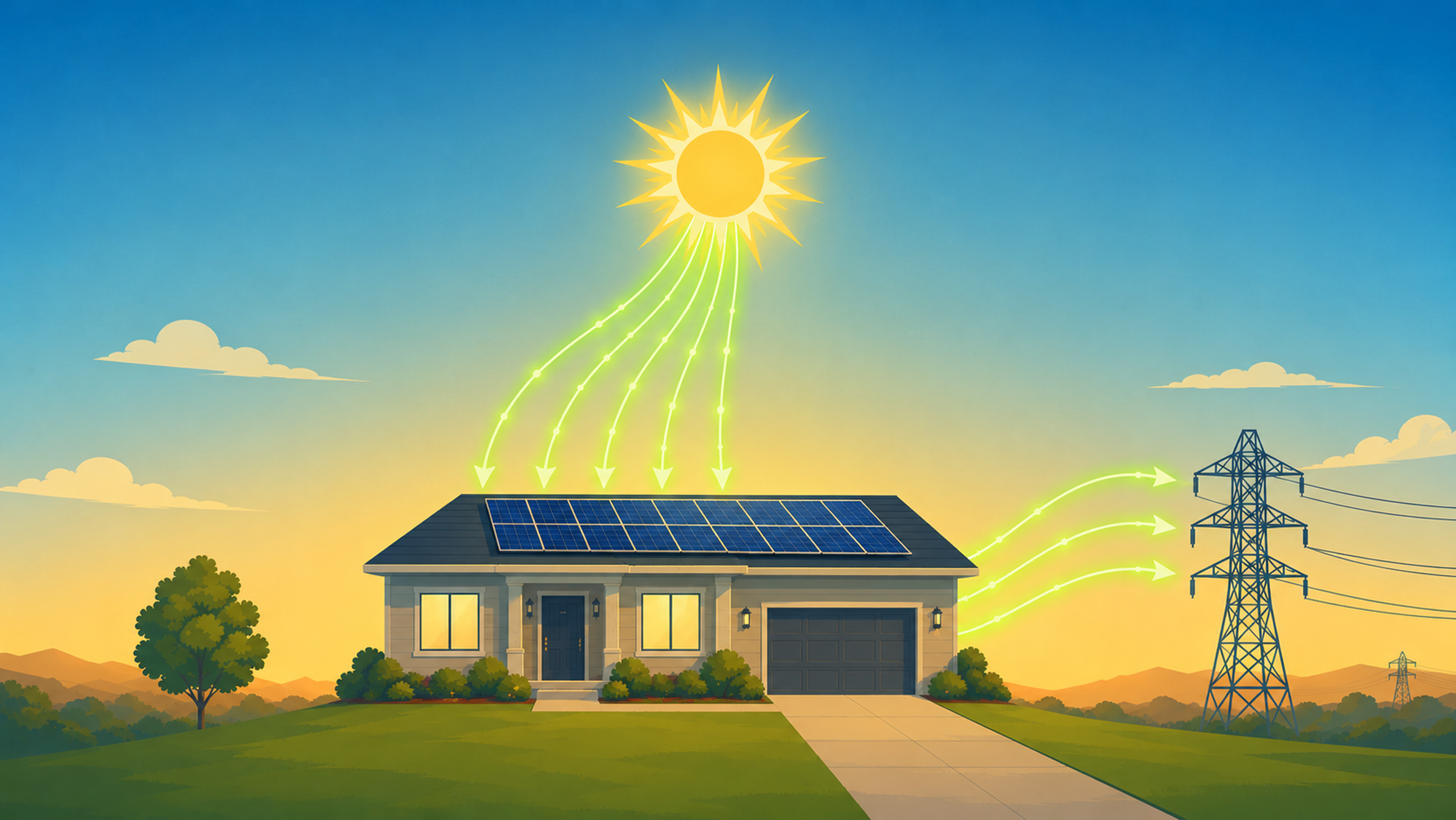
Start with how federal tax policy has shifted. Homeowners used to be able to claim a 30% tax credit on battery systems they purchased directly through Section 25D. That’s now gone. But Section 48E, the Clean Electricity Investment Tax Credit, remains intact for companies and investors who deploy energy storage assets. One model is for Third Party Owners (TPO) to own and operate fleets of batteries installed in customer homes. The base credit is 30% for residential projects, but it can stack significantly higher: domestic content adds another 10 percentage points, and locating in an energy community adds 10 more. A TPO company that checks all the boxes could capture up to 50% of the installed cost in tax credits. This fundamentally changes who should own home batteries. The tax benefits now flow to asset owners who can meet these requirements, not to individual homeowners buying systems for their own homes.
The solar industry spent years proving that TPO structures work for residential installations. Homeowners get the benefits of the system with little to no upfront cost, while investors capture tax credits and long-term revenue streams. Those same models are now being applied to home batteries, and the unit economics are even more attractive because batteries have multiple revenue streams beyond just offsetting electricity costs.
Which brings us to Virtual Power Plant programs. Utilities and grid operators are increasingly willing to pay homeowners for access to their battery capacity during peak demand periods. These VPP programs can generate $1000 to $4000 per year in many markets, creating a predictable revenue stream that makes the investment math work for both homeowners and investors.
Add it all up and you have cheap hardware, strong federal incentives for asset owners, proven financing models, and new revenue streams. When all of these factors converge, you don’t need to sell a luxury good anymore. You can deploy an asset that generates returns for investors while delivering value to homeowners at little to no upfront cost.
What Happens When You Stop Trying to Impress Guests
Here’s the key insight that’s driving this transformation: home batteries don’t need to hang on your wall in your garage where you can admire them.
Think about the other major energy systems in your home. Your AC unit sits on a concrete pad on the side of your house. Your water heater lives in a utility closet or garage corner. If you have a standby generator, it’s probably next to your AC unit on another concrete pad. None of these products are designed to be beautiful. They’re designed to be functional, reliable, and cost-effective. Nobody sees them, nobody thinks about them, and they’re in tens of millions of American homes.
What changes when you design a home battery as an appliance instead of a premium product? Almost everything about the cost structure improves.
Manufacturing costs drop dramatically when you’re building an appliance-grade enclosure instead of a premium wall-mounted unit with carefully designed aesthetics. You can use standard materials and proven manufacturing processes instead of custom industrial design. The product doesn’t need to make a visual statement, so you optimize purely for function, durability, and cost.
Installation complexity decreases significantly. A pad-mounted battery system sitting next to your AC unit requires much simpler installation than a wall-mounted system in your garage. The electrical connections are straightforward. You don’t need specialized mounting hardware or concerns about wall loading.
Maintenance becomes more standardized. When you’re working with an appliance-grade product sitting outdoors on a pad, service procedures look more like HVAC service than custom electronics repair. This makes ongoing maintenance cheaper and more accessible.
This isn’t about making batteries worse to make them cheaper. It’s about recognizing that the premium design approach was optimized for a different market and a different customer. The mass market doesn’t need batteries to be beautiful. They need them to be affordable, reliable, and invisible.
The Business Model Transformation
The shift from luxury good to appliance enables a completely different business model, and that’s where the real transformation happens.
The old model relied on high customer acquisition costs. You needed commissioned sales teams to educate homeowners about the value proposition, walk them through the technology, design a custom solution, and close a complex sale. The sales cycle could take months. You were asking homeowners to write a check for $15,000 to $20,000, which meant you needed to spend significant time and money convincing them it was worth it. Only wealthy homeowners could afford to say yes, which meant you were fishing in a very small pond.
The new model flips this completely. When the unit economics work (low-cost hardware plus strong incentives plus grid revenue potential), you can offer systems with little to no upfront cost to homeowners. This changes everything about how you go to market.
Under a TPO structure, homeowners get immediate benefits like backup power and bill savings, while investors capture tax credits, VPP revenue, and long-term electricity savings. The homeowner isn’t buying a product anymore. They’re agreeing to host an asset that benefits them while generating returns for someone else. That’s a much easier conversation than asking for $15,000 upfront.
The math works because all the pieces have come together. Let’s say you can deliver hardware, installation, and soft costs for $400 per kilowatt-hour. A TPO company captures the 30% federal tax credit, bringing the net cost down to $280 per kWh. Use domestically manufactured batteries and that’s another 10 points, dropping net cost to $240 per kWh. Deploy in an energy community and you could be looking at $200 per kWh after credits. These aren’t benefits a homeowner can access by buying a system outright anymore. They’re available exclusively through third-party ownership structures.
Add VPP revenue that could generate $1000 to $4000 per year depending on the market and utility programs. Factor in the utility bill savings from time-shifting usage and avoiding peak rates. Model it out over 10 to 15 years and you get an IRR that makes the investment attractive to institutional capital.
For the homeowner, it’s a straightforward value proposition: you get backup power, lower electricity bills, and participation in grid services, often with zero upfront cost. The “sale” becomes a simple financial decision with clear benefits rather than an emotional purchase requiring deep pockets.
This dramatically expands the addressable market. Instead of targeting the top 5% of homeowners by income, you can target any homeowner with decent credit and a compatible electrical setup. That’s the difference between a niche luxury market and a mass-market appliance category.
What This Means for Everyone Involved
For homeowners, this transformation makes backup power and grid participation accessible in a way it simply hasn’t been before. You don’t need to be an early adopter with $20,000 to spare. You can get the benefits of a home battery system through a structure that makes economic sense for your household budget. The battery becomes like your HVAC system: essential infrastructure you don’t think about day to day, but you’d absolutely notice if it wasn’t there.
The implications for the broader energy transition are significant. Scale changes everything. A technology that’s in 1% of homes is a curiosity, yet the same technology in 20% of homes is infrastructure. At meaningful scale, distributed home battery storage addresses several critical challenges simultaneously.
Grid constraints get easier to manage when you have distributed storage capacity that can absorb excess solar production during the day and discharge during evening peak demand. You don’t need to build as much new transmission infrastructure or large-scale utility batteries if you’ve got millions of home batteries providing the same grid services in a distributed way.
Higher renewable penetration becomes viable because storage handles the intermittency problem. Solar production peaks midday when demand is lower, and distributed battery storage can capture that excess production for use during evening hours when demand spikes and solar production drops to zero.
Grid resilience improves through distributed resources. A major outage that takes down a centralized power plant or transmission line can be partially offset by thousands of home batteries providing backup power in their local areas. This doesn’t replace utility-scale infrastructure, but it makes the overall grid more robust and less vulnerable to single points of failure.
Electrification becomes more affordable and practical. As more homes add heat pumps, induction stoves, and especially EV chargers, the load on the grid increases substantially. Distributed battery storage helps manage those loads by time-shifting consumption away from peak periods and reducing the need for expensive grid upgrades.
For the industry, this transformation isn’t about one company winning or losing. It’s about the entire sector maturing from a niche market selling luxury goods to a mainstream market deploying essential appliances. Companies that recognize this shift and adapt their products, business models, and go-to-market strategies accordingly will scale. Those that continue optimizing for premium positioning and luxury buyers will find themselves serving a shrinking niche as the mass market moves in a different direction.
Why This Is Happening Now
These forces have been building independently for years, but they’re converging right now in a way that creates the conditions for rapid market transformation.
The battery supply chain took over a decade to mature to this point. Gigafactory construction, manufacturing process improvements, and scale economies don’t happen overnight. But we’re now at the point where global battery production capacity significantly exceeds near-term demand, and that changes pricing dynamics fundamentally.
Policy support through Section 48E gives the industry the structure it needs to build business models around third-party ownership. The ability to stack credits for prevailing wages, domestic content, and energy community locations creates meaningful incentives for companies that can meet those requirements. And the transferability of credits means even entities without significant tax liability can monetize the incentives through transfer or direct payment mechanisms.
Grid needs have become acute over the past few years. The combination of expanding AI infrastructure and data centers, renewable energy growth, vehicle and building electrification, and aging infrastructure has created real constraints that utilities and grid operators need to solve. Distributed battery storage addresses multiple problems simultaneously, which makes the value proposition much stronger than it was even five years ago.
Business models have been proven in adjacent markets. The residential solar industry spent years figuring out TPO structures, customer acquisition strategies, and operational processes. Battery storage can leverage all of that learning rather than starting from scratch.
This reminds me a lot of what happened with residential solar between 2008 and 2012. Solar panels were expensive luxury items that only wealthy environmentalists installed. Then costs dropped, incentives aligned, and financing models emerged. The result was explosive growth. Residential solar installations went from under 100,000 per year to over 500,000 per year in less than a decade.
Home batteries are following the exact same trajectory, just 10 to 12 years later. The technology has matured. The costs have dropped. The incentives have aligned. The financing models are proven. All the pieces are in place for the market to scale rapidly.
The Boring Future Is the Bright Future
Let me bring this back to where we started: that AC unit sitting on a concrete pad on the side of the house.
Nobody brags about their AC unit. Nobody gives guests a tour to show it off. It’s not a status symbol. It doesn’t make a design statement. It’s just there, doing its job, completely unremarkable.
But try living without one in Phoenix in July. Or Houston in August. It’s not a luxury. It’s essential infrastructure that makes modern life possible in much of the country.
That’s where home batteries are headed, and that’s exactly where they need to be for the energy transition to succeed. The luxury era served its purpose. It proved the technology works. It built out supply chains and trained installers. It established the basic market and demonstrated customer value. But that chapter is ending.
The next chapter isn’t about better marketing of premium products to wealthy early adopters. It’s about recognizing that the market has fundamentally changed and the winning strategy has changed with it. The path from 1% adoption to 20% adoption runs through making batteries boring, affordable, and accessible. That means embracing the appliance form factor, the streamlined business model, and the mass-market positioning.
In five years, we’ll look back and wonder why it took the industry so long to figure out that the battery doesn’t need to be beautiful. It doesn’t need to hang on your wall where you can see it. It doesn’t need to make a statement.
It just needs to work. And it needs to be in millions of homes instead of thousands.
That transformation is happening right now. The companies and business models that recognize it and adapt accordingly are going to define the next decade of residential energy storage. The ones that keep trying to sell luxury goods will find themselves serving an ever-smaller niche while the mass market moves on without them.
The future of home batteries is boring. And that’s the best news possible for homeowners, for the grid, and for the energy transition we all need to make happen. Because boring means accessible. Boring means affordable. Boring means it’s not just for the wealthy few anymore. And boring means we can finally deploy this technology at the scale the energy transition actually requires.
Find out where your electricity is actually going.
The Vue monitors every circuit in your panel and shows exactly what's using energy and what it costs. Average customer saves 10% or more monthly.